Turning Your Idea into Reality with Glass
Hosted by: The University of Texas at Austin Chemistry Department Glass Shop and Texas Materials Scientists & Engineers
STEM Girl Day Glass Shop Imaginary Invention Contest
Calling all K-8th graders: Do you have an idea for an imaginary invention that can solve a real problem in our world? Imagine an invention that will solve a real problem in our world. What would the invention look like? How would it work? What will it do?
Participants will use no more than one page or piece of paper to draw and describe their invention idea, how it works, and/or what problem it is solving in our world. A team of STEM students and professionals will select one idea from STEM Girl Day at UT Austin submissions and will bring this idea to life as an artistic glass sculpture.
Contest Submission Instructions:
Below is the timeline for the 2026 STEM Girl Day Glass Shop Imaginary Invention Contest, which is CLOSED. See the winner and honorable mentions of the contest below.
The deadline to complete the following THREE steps is Wednesday, February 4, 2026.
- Create a hand drawing and a hand-written description of your invention. The invention drawing and description should be no larger than one 8.5x11 image/paper. The invention drawing and description should include the invention's name, the student's first name (ONLY first name), and a picture and/or description of the invention, how it works, and/or what problem it is solving in our world. Do not use AI and do not type or use technology to draw or write out your description - hand drawings and hand-written descriptions only.
- Submit a PDF, JPG, or PNG of the invention idea and complete the online submission form by Wednesday, February 4, 2026. The submission form requests the student's first and last name (the last name will not be shared publicly), student grade, student school, and city/state, as well as the adult's first and last name, and adult email address.
- Upon completion of the submission form, a confirmation email will be sent with the final submission step instructions. In the confirmation email, you will be asked to upload a PDF, JPG, or PNG of the invention idea to the 2026 STEM Day Imaginary Invention Contest Padlet, the platform where our team of scientists and artists will be able to view and provide comments for all submissions. All submissions are moderated and will be approved and visible by Friday, February 6, 2026.
Contest Timeline:
- Contest Opens: Monday, December 1, 2025
- Contest Submissions Close: Wednesday, February 4, 2026
- Contest Submissions Viewable on Padlet: Friday, February 6, 2026
- Contest Winner Announced: Monday, February 23, 2026
2026 STEM Girl Day Glass Shop Imaginary Invention Contest
Congratulations to the 2026 STEM Girl Day Glass Shop Imaginary Invention Contest Winner and Honorable Mentions!
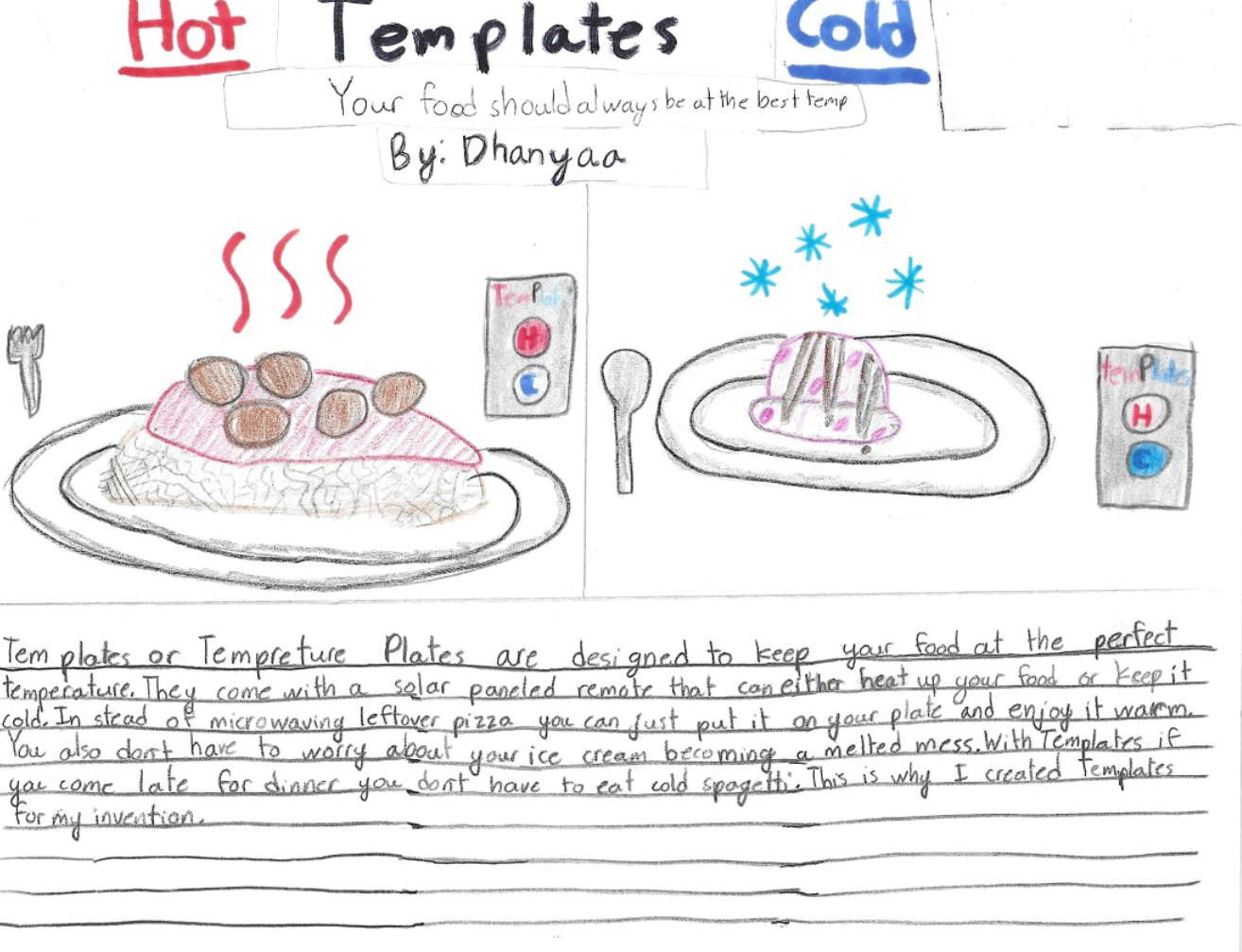
Contest Winner: "TEMPLATES" by Dhanyaa S.
Honorable Mentions:
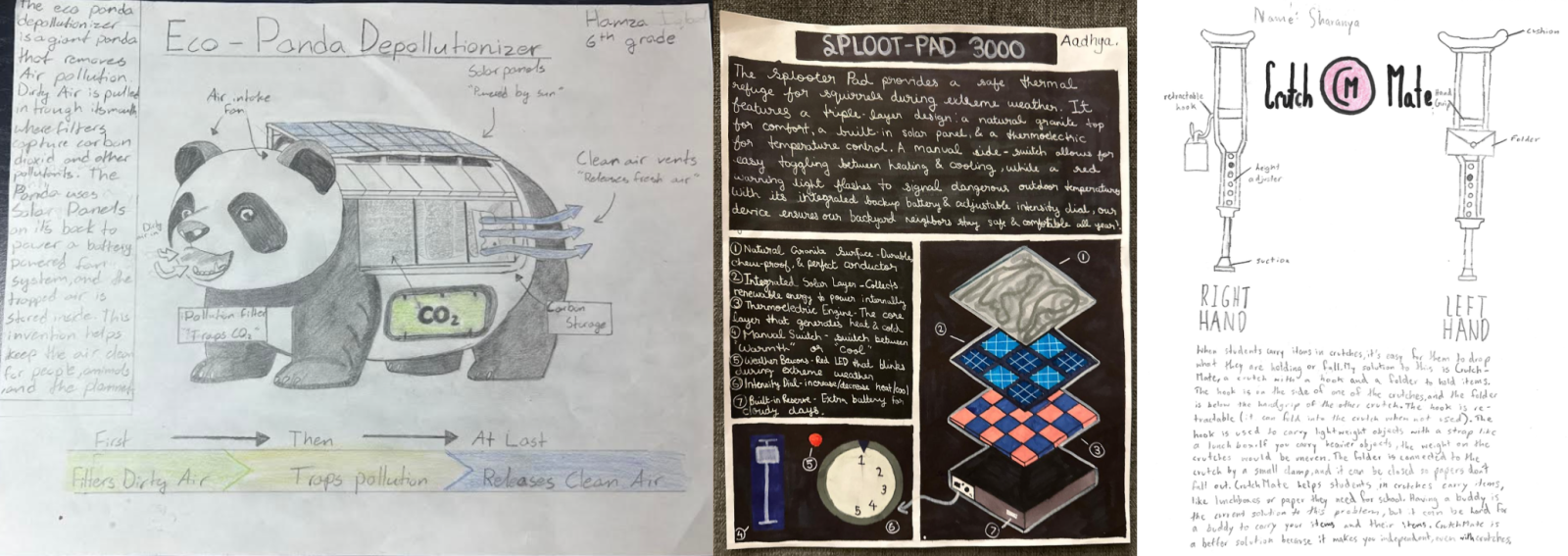
- "Eco-Panda Depollutionizer" by Hamza I.
- "SPLOOT-PAD 3000" by Aadhya A.
- "Crutch Mate" by Sharanya R.
See the winning and honorable mention submission drawings and descriptions below, and view all of the contest submissions in the Flickr album and on the Padlet page. Posters of these submission drawings will be on display at 2026 STEM Girl Day on Saturday, February 28, 2026. The winner, "TEMPLATES," will be made into a glass sculpture.
Thank you to the UT Austin Department of Chemistry Glass Shop and Texas Materials Scientists & Engineers, especially Adam Kennedy and Vaibhav Sridhar, for making this contest a success.
Check out Invention Submissions from Past Contests
Congratulations to the Summer 2025 Glass Shop Imaginary Invention Contest Winners!
Contest Winners:
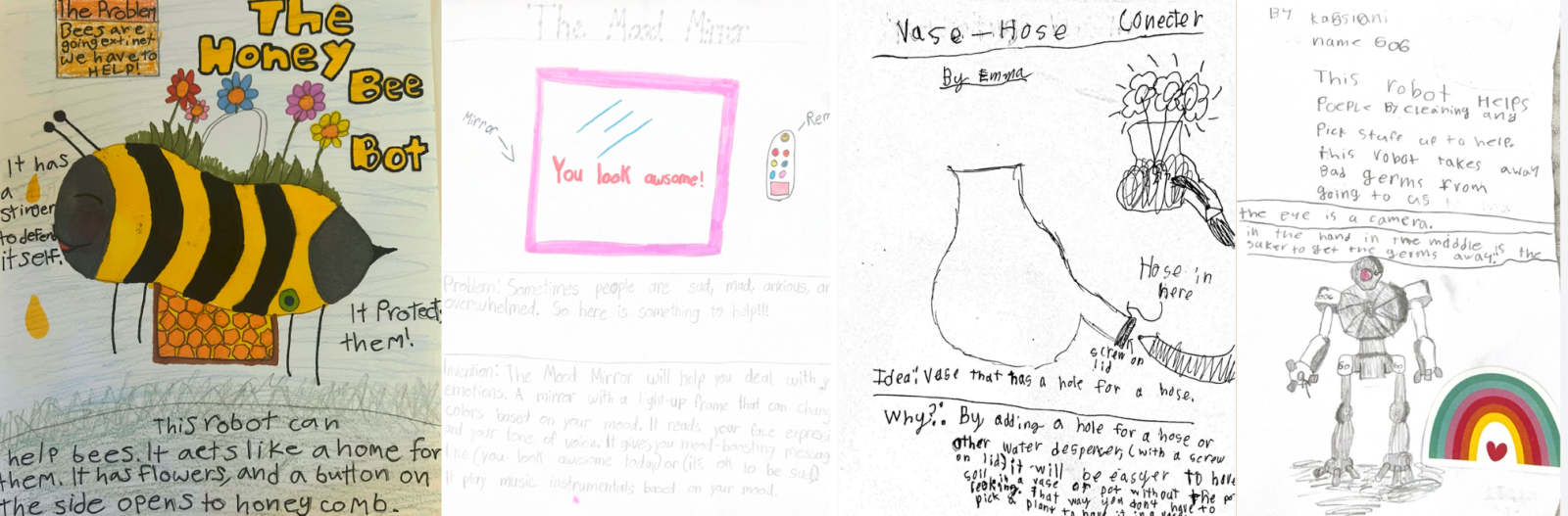
- "The Honey Bee Bot" by Swayze M.
- "The Mood Mirror" by Kaelyn S.
- "Vase-Hose Connector" by Emma G.
- "No Name Robot (606)" by Kassiani S.
See the winning submission drawings and descriptions below, and view all of the contest submissions in the Flickr album and on the Padlet page. The glass sculptures of the four winning inventions will be on display at 2026 STEM Girl Day on Saturday, February 28, 2026.
Thank you to the UT Austin Department of Chemistry Glass Shop and Texas Materials Scientists & Engineers, Adam Kennedy, Alex Esser, Ashot Tumaghyuan, Jack Woelfel, Jasmine Liu, Mark Andrews, Ramya Srinivasan, Ridhima Gupta, and Taylor Drattlo for helping bring the winning inventions to life.
The winners of the 2025 STEM Girl Day Glass Shop Imaginary Invention Contest are featured below. The glass sculpture of the People's Choice Winner, "Robotic Elephant," will be on display at 2026 STEM Girl Day on Saturday, February 28, 2026.
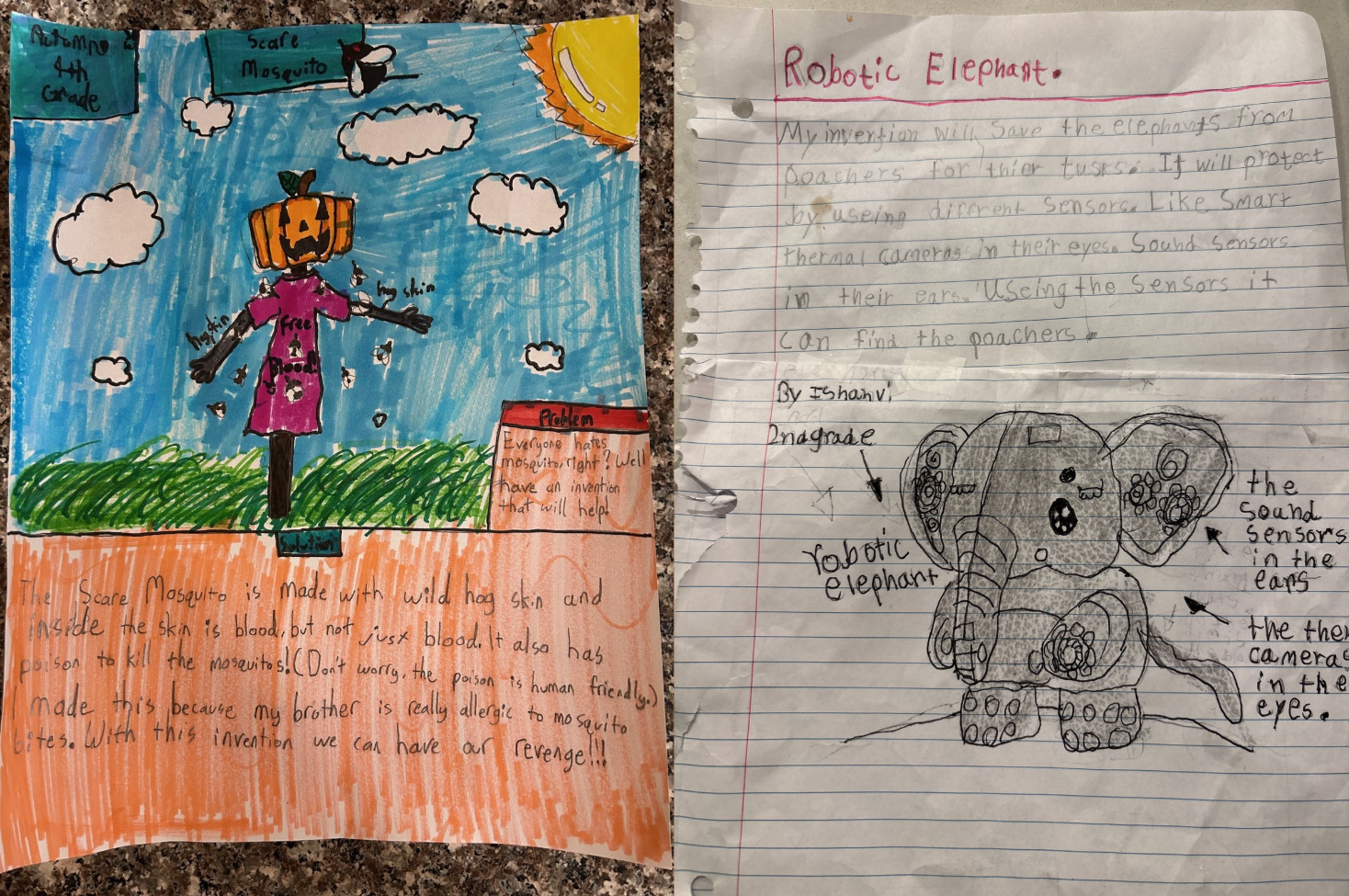
- Contest Winner: "The Scare Mosquito" by Autumn M.
- People's Choice Winner: "Robotic Elephant" by Ishvani S.
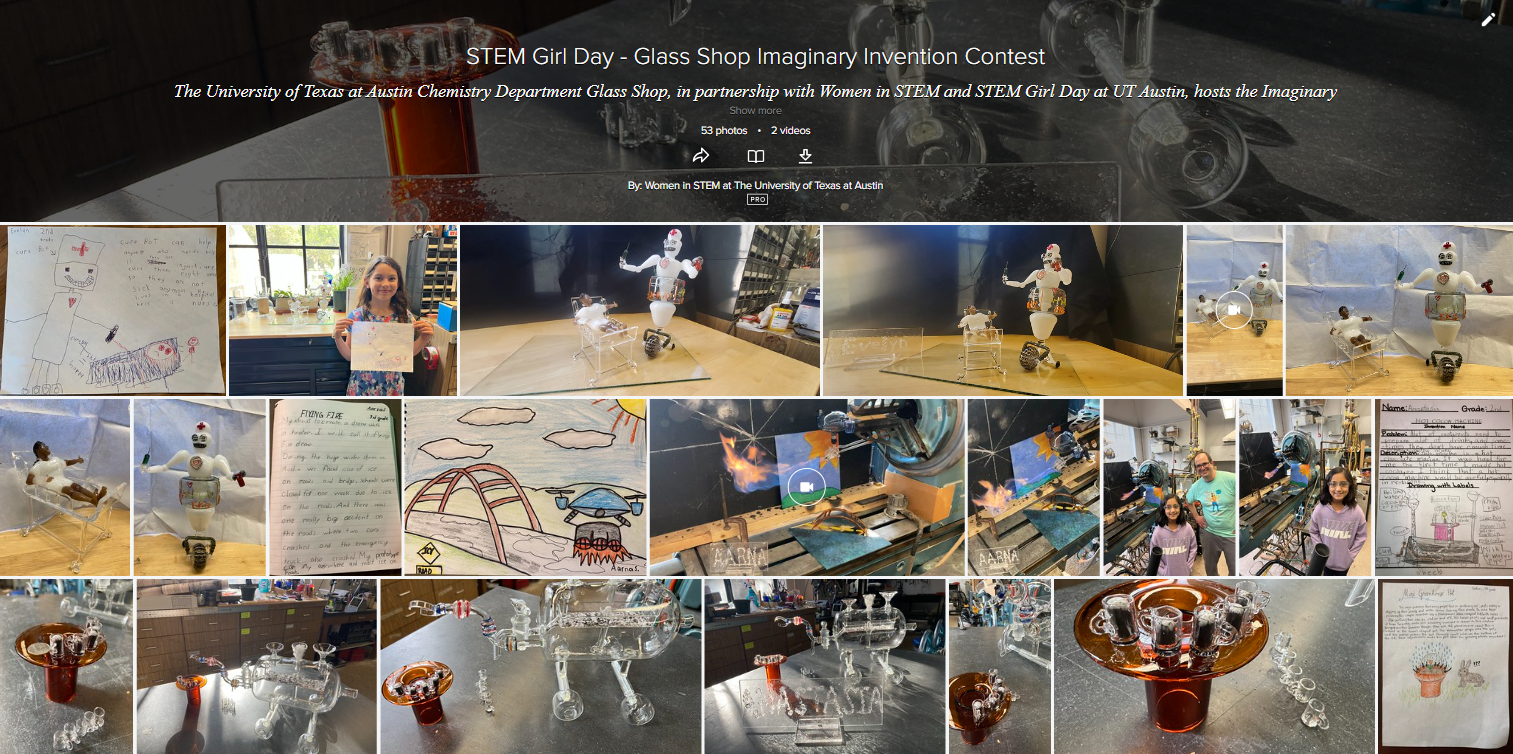
View all of the contest submissions in the Flickr album and on the Padlet page.
Find photos and videos of Invention Ideas from STEM Girl Days on Flickr.
Learn More about the Glass Shop
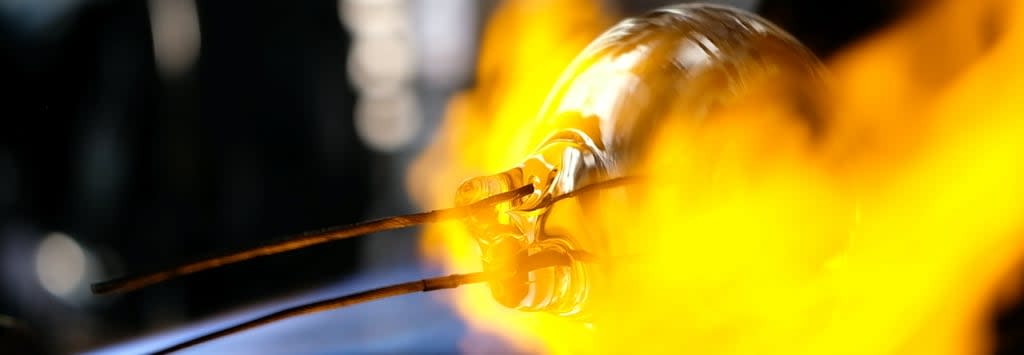
Without glass, the world would be unrecognizable. It’s in the eyeglasses on your face, the lightbulbs in your room, and the windows that let you see outside. From the lenses of telescopes used to discover other worlds to the glassware used in chemistry to the optical fibers used to transfer information across continents, glass has also been critical to scientific discovery. Here at the UT Glass Shop we continue to enable world-class research through scientific glassblowing. You can usually find us fixing broken glassware and making complex apparatuses for researchers. Today though we thought we would showcase the immense engineering needed to create one of the most common glass-containing items we encounter every day: the light bulb.
Although many believe that Thomas Edison invented the light bulb, he was not the first to show that light could be produced by passing electricity through a filament (a thin wire). Edison’s light bulb was the first that could be used long enough to be adopted for widespread use lasting up to 1,200 hours (50 days) before burning out. The next major milestone was replacing Edison’s carbon filament with a tungsten filament that lasts up to 10,000 hours and is still in use today. The filament is surrounded by a glass bulb and all of the air is removed from inside the glass bulb to protect the filament from burning out. Glass is used because it is transparent and can withstand the high temperature of the filament which can reach 4,500°F (10 times hotter than your oven at home).
How does this activity connect to STEM?
- The light bulb is a great example of the engineering needed to light our world and was a major milestone in human development.
- Incandescent light bulbs like the one we are making today are not used as much now because more energy-efficient alternatives are used like LED light bulbs.
- While light bulbs are made by large, automated machines in factories, our journey of making one by hand showcases the range of skills needed to make such a simple item.
- Skills we are using today include scientific glassblowing, machining of filaments, chemistry and electronics.
More about the UT Glass Shop
The Glass Shop at UT is located in Welch Hall (WEL) 2.146 and is staffed by Adam Kennedy. We create, repair, and modify various glass instruments for departments throughout the university. This can be as simple as fixing a small crack, or as complex as collaborating with scientists to create an entirely new design and building it from scratch. While most people think we make beakers and test tubes, scientific glassblowing is much more complicated than that requiring a great deal of planning and experience to make the apparatuses needed. The work we do here enables UT research amongst a broad range of disciplines.